Ross Museum receives dream-like makeover

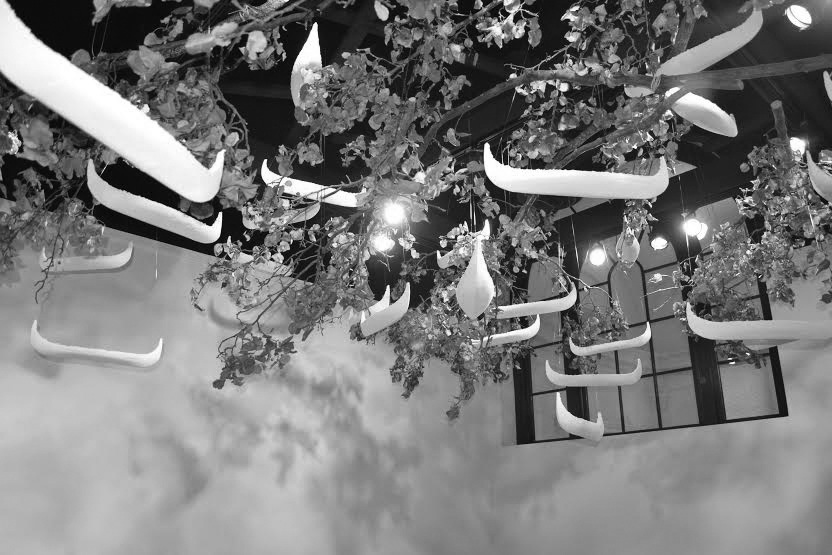
A piece from Elizabeth Fergus-Jean's "Dreamscapes" exhibition, now on display at Ross Art Museum. Photo by Olivia Lease
A piece from Elizabeth Fergus-Jean’s “Dreamscapes” exhibition, now on display at Ross Art Museum. Photo by Olivia Lease

By Olivia Lease
Transcript Reporter

There are three new exhibits at the Richard M. Ross Art Museum, one of which was  specifically designed for the museum that will never be showcased again.

All of the work on exhibit was done by a husband and wife duo from the Columbus area, Elizabeth and John Ferges-Jean. Previously, they had never shown their work together.

The exhibit opened Nov. 9 and will remain up until Dec. 18.

The first exhibit, “Dreamscape” was done by Elizabeth Fergus-Jean. It showcases 100 white paperclay boats floating amidst tree limbs.

Elizabeth said that the tree limbs were very difficult to come by and she had to contact several different Columbus tree-trimming services.

It was important for her to use real, rather than fake branches.

“One of the things that I really like to do with my work, because it is environmentally based, is to have people reconnect their direct relationship with nature and reestablish the beauty and wonder and profound impact,” she said.

She had no say in what type of branches she received.  Originally, her concept didn’t involve leaves but as an installationer, she said she has to be malleable. In the end, she was given a truck full of ornamental pear tree limbs the day before installation began.

Students in the Gallery Management class typically spend 6-9 hours working on an exhibit the week before it is opened.

Senior Sarah Sakov said that “when I ended up helping, there were branches spread out all over the floor of the entry way.” Sakov said she enjoyed collaborating with the artist and getting to see her realize her vision.

“Dreamscape” required some back-up to be called in. Elizabeth said that seven of her grad students at Columbus College of Art and Design did a fabulous job helping her.

Ross Art Museum’s Director, Justin Kronewetter said they did not foresee the extra costs coming with this exhibit. Almost an extra $1,000 was spent on step ladders and scaffolding.

This exhibit was hung up in layers over the span of five days.

Elizabeth noted that the image of the boat she has been using since 1990 as a metaphor for the vessel that takes us through life.

“It just has this profound archetypal resonance for when you see it just floating, it awakens the imagination,” she said.

The second exhibit, entitled “Penumbrae” is by John Fergus-Jean.

It focuses on how with the erosion of photos, memories become more and more distant over time.

He says Penumbrae is how every shadow has a dark part but it also has a lighter part towards the edge, and that part that contains light and darkness.

“So these images to me contain the light of knowing and then the darkness of not knowing,” he said.

The size and formation of the pieces mimic original daguerreotypes. They were created in 2014 but the images he has been working with for a while.

John is a master printer and did the prints for the third exhibit, “Awe” by Izze Frances. Frances is actually a pseudonym used by Elizabeth to separate her photographic work from the rest of her work.

“The word ‘awe’ is the awe in life. To become re-enchanted with the everyday ordinary,” she said.

The photos showcased were taken in 2012 while she and John were on sabbatical.

All three exhibits can be viewed at the museum Tuesday, Wednesday, and Friday from 10 a.m. to 5 p.m. As well as Thursday from 10 a.m. to 9 p.m. and Sunday 1 to 5 p.m.
Walking on the Olentangy’s wild side

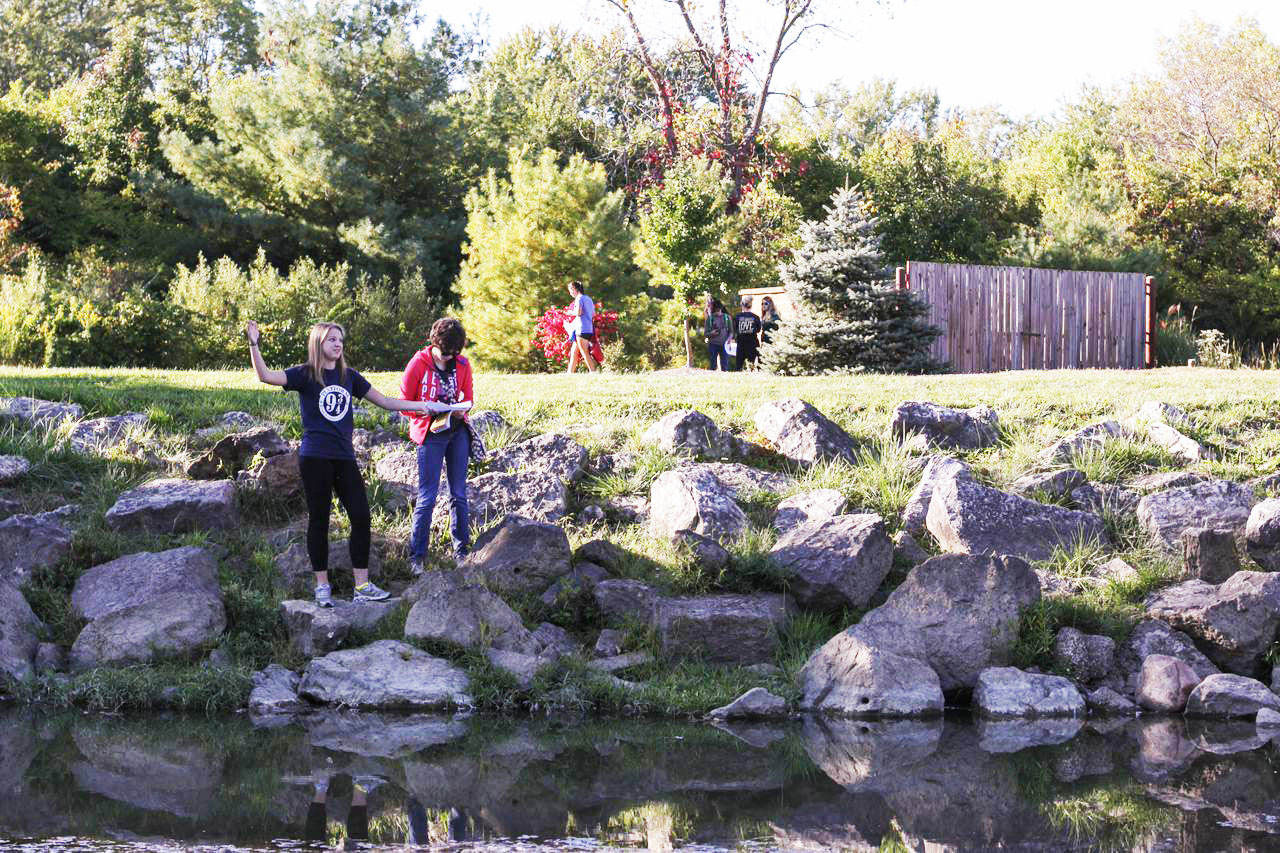
Students skip rocks into the Olentangy River on a river exploration trip for students in the American Landscape Course Connection. Photo by Alex Gross


Next to a bustling highway, Ohio Wesleyan students and faculty explored the tranquil biodiversity of the Olentangy River.

While exploring, students took samples of foliage, poured weak acid on rocks, ventured into the water and even tasted wild carrots.

The event, Walk on the Wild Side, was hosted by the American Landscape Course Connection (ALCC), which sponsors a landscape-based event every semester. It took place on Sept. 23 from 5-7 p.m.

Geology Professor Karen Fryer said she liked the “juxtaposition of the natural and the human contribution.” The most beautiful thing Fryer said she saw was a blue heron in flight.

Students participating were split up into groups of eight, given instructions, a sheet to identify plants, and binoculars before setting out.  Along the river, areas roughly 100 yards long were marked for students to observe.

Several classes participated and therefore were looking at the land in a truly interdisciplinary way.

“Well, with the help of the botany majors I was able to identify pretty much all the plants,” said junior Scott Woodward.  He said that he would have only been able to identify a few without them.

Junior Daisy Von Glaeser is in Professor David Johnson’s Biodiversity of Flowering Plants course and said her group “only saw one or two native plants”.

One of the groups saw a few historical markers, one marking a place the Underground Railroad passed through.  Another marked the site of Ohio’s Worst Natural Disaster, a 1913 flood where about 20,000 homes were destroyed and more than 400 people died.

One student even found a stone with a “W” etched into it as the mason’s mark.

Freshman Sharon Hayes, who is taking Geology 110, said that she was able to identify a few rock specimens. “We found calcite, we got a weak acid from Fryer, poured it on the rock and it reacted,” she said.  A few people in her group ventured into the water and saw minnows, freshwater clam shells and some crawfish, she said.

One group saw a single person tent and realized they were no longer surveying “the wild” but also someone’s makeshift home.

Planning for the event took place at a meeting of ALCC faculty in August said coordinator English Professoor Lynette Carpenter.  “We started with the bioblitz concept of recording every species and expanded it to include, for example, geological concerns and cultural artifacts, as well as sound and touch and feelings.” said Carpenter.

The event’s aim was to promote course connections and “to let students experience a multidisciplinary approach to the landscape and have fun doing it,” said Carpenter.

After groups spent roughly 45 minutes exploring their segment of land, they returned to the Science Center Atrium for snacks and refreshments.

Each of the six groups sent pictures to professor of music Nancy Gamso, who put together presentations on site.

“I thought students seemed interested, and invested in their presentations, which went very well, so I was quite pleased with the event,” said Carpenter

“An interesting take-away was that there were both commonalities and distinct differences along different stretches of the river,” said Fryer.

Overall, the event was positively received.

“I got to walk outside, I got to identify plants with my friends, and I got to eat some snacks,” said Woodward.