President Donald-elect J. Trump’s Policies: Energy and the environment

By Olivia Lease, Transcript Correspondent

Newly elected President Donald Trump has big plans in terms of energy policy for when he is sworn into office

in 2017. Those plans include expanding employment opportunities and moving toward energy independence as a nation.

In terms of the environment, though, expect continued use of conventional energy sources, in particular, fossil fuels such as coal and oil and newer sources such as natural gas.

Despite previously stating that climate change was a hoax perpetrated by the Chinese and then denying this statement,

Trump will be making an effort to limit greenhouse gas emissions such as CO2, NH4 and nitrous oxides. The main effort being to look into and utilize what his experts expect to be “hundreds of years in clean coal reserves.”

In a National Geographic article from 2014, it was found that burning coal with little to no emissions (most being captured and stored), most commonly phrased as “clean coal” is possible in theory but as a long-term practice on a wider scale, not so much.

At a rally in Michigan on Oct. 31, Trump said, “We’re going to put America first. That includes canceling billions in climate change spending for the United

Nations, a number Hillary wants to increase, and instead use that money to provide for American infrastructure including clean water, clean air and safety.”

A relatively untouched topic during the presidential campaign trail, environmental policy may be coming to the forefront in the wake of the Paris Agreement signed by President Obama in April 2016.

The Paris Climate Agreement was established within the United Nations Framework Convention on Climate Change (UNFCCC) dealing with green- house gases emissions mitigation, adaptation and finance starting in the year 2020.

Trump plans to cut ties with the agreement he said at a rally in Bismark, North Dakota on May 26, 2016. He claimed Obama entered the Paris Agreement without the permission of Congress and that because of this and a few other factors, he will back out of the deal.

By cutting all federal spending on the issue of climate change, Trump will save $100 billion over two terms in office in an effort to “cancel all wasteful climate change spending,” he said.

While in office, Trump plans to reduce and eliminate all barriers to what he called “responsible energy production,” creating at least a half million jobs a year, $30 billion in higher wages and cheaper energy.

According to his site, Trump will “unleash America’s $50 trillion in untapped shale, oil and natural gas reserves, plus hundreds of years in clean coal reserves.”

Trump plans to look into different means of safely extracting coal, shale, natural gas and oil with plans of opening onshore and offshore leasing on federal lands, eliminate moratorium on coal leasing, and open shale energy deposits.

With Tump in the Oval Office, expect a lot more carbon dioxide polluting the atmosphere.

Homecoming hosts trustee meeting

By Leah Miza, Photo Editor and Olivia Lease, Transcript Reporter

In his opening comments, President Rock Jones urged the Board of Trustees to think “strategically about the long-term for Ohio Wesleyan.”

On Oct. 7, the Board of Trustees sat down to discuss a variety of issues that would impact the campus. Gathered for lunch on the third floor of Merrick Hall, it was a snug fit but almost all the members were all there.

Chairperson Thomas Tritton ’69, led the meeting during which everything from new classes to the the cost of tuition were discussed.

Liberal arts schools only make up 200 of the 3,036 four- year colleges in the U.S. That means only about 15 percent of four-year institutions are liberal arts in the United States.

“That represents a really, really tiny sliver of the number of students who are college students,” Tritton said.

“Even those at the very top are having problems because they become increasingly expensive and generally inaccessible to large segments of the population. So we’re really all in this together,” said Tritton in regards to increasing enrollment and making a liberal arts education more affordable.

Enrollment is up by about 50 students this year, which means the preliminary school budget had be adjusted to account for the extra $2.2 million. The funds were distributed across a few areas, one being the food budget, which increased by 2 percent.

Despite this higher enrollment, the board voted to increase tuition, room and board by 1.5 percent for the 2017-18 school year. This is roughly $833 per residential and international student (off-campus and commuter students will see a lower amount).

In an email, Jones noted that this increase is lower than in many past years in an effort to hold down costs for students and for the school to continue providing an outstanding liberal arts education.

The board also addressed the importance of improving OWU’s retention rate and the effectiveness of academic ad- visers. An online catalogue and a new app will be introduced to help students track their classes and the progress of their major(s) and/or minor(s).

With this technology, advisers could focus on helping students pursue their interests and different opportunities without being bogged down by prerequisite courses neces- sary for graduation.

New housing opportunities were also explored during the meeting. A motion was made for the construction of a new Honors House to be located on Oak Hill Avenue, next to the House of Peace and Justice.

An anonymous $2 million donation was made for the space that may be able house 30 students in comparison to the 11 students the Honors House currently holds.

The motion passed with no objections. “We have the money; let’s go for it,” said Tritton. Plans to start construc- tion are being laid out and students should be able to move into the house in the fall of 2017.

One of the Small Living Units (SLUs) in an older house on campus will be eligible to move into the current Honors House which is located at 123 Oak Hill Ave., a few doors down from the president’s house. Plans for housing that is specifically for first-year students is also in the works.

The process of finding a broker for the New York Arts building started over the summer and the school-owned property is expected to be listed as for sale soon. Funds from the possible sale would go to other departments such as maintenance, which, on average, the school spends $1 million on annually and it is usually, “cobbled together funds,” as Trustee C. Paul Palmer IV ’96 said.

Trustee Colleen Nissl ’72, gave marketing and enrollment report to the board. She started by congratulating the Communications Office, which launched the new website in November 2015. In the past six months, the website has had over a million hits, Nissl said.

In terms of enrollment, Nissl said the school is now 52 percent male and 48 percent female, the exact opposite of surrounding schools and might partially be due to the recruitment for sports.

With this incoming class, the percentage of multicultural and transfer students are down while Ohio and Chicago-based students are up.


Both Jones and separate members of the board addressed that while the 2020 plan is on course, it’s important to keep in mind long-term goals.

The next time the Board of Trustees will meet is during their retreat in Naples, Florida in February 2017.

Look closer: being a mindful consumer

An organic pineapple plantation in Costa Rica. Photo by Olivia Lease.
An organic pineapple plantation in Costa Rica. Photos by Olivia Lease.

Olivia Lease, Online Editor

I try to see stories in everything I purchase.

I wonder whose hands made the sweater resting on my shoulders or where the watermelon I am currently eating was grown, picked, washed and perfectly sliced.

I don’t like to go shopping very often. There are so many options that it is no longer exciting but overwhelming. I can walk into a store and see thousands of cheaply priced goods in front of me. What I don’t see are the hidden costs, I have to search for the real stories.

Organic pineapples being grown in Costa Rica, most of which to be transported elsewhere. Photo by Olivia Lease.
Organic pineapples being grown in Costa Rica, most of which to be transported elsewhere.

I think it’s time for us to acknowledge the fact that we live in a consumer-centric society made possible by the hard work of others. People we will most likely never meet but whose stories matter.

But first, let’s acknowledge the fact that our supermarkets no longer abide by the seasons.

You can buy a pineapple at any time, regardless of that fact that we are not living in Brazil or Paraguay, where the plant originated. It has now been spread throughout South America. I visited Costa Rica over winter break and was able to a tour a plantation.

There, some of the crops we saw would eventually travel over 3,000 miles to reach California while some would go even further destinations in the U.K.

A single pod of fruit from which palm oil is extracted. Photo taken in Costa Rica by Olivia Lease.
A single pod of fruit from which palm oil is extracted.

When we walk into a store, we don’t see the hours of hard labor or the elaborate transportation system it took to give us more choices. Variety is simply something we’ve become accustomed to.

While in Costa Rica, I also had the chance to tour a palm oil plantation.

The edible vegetable oil is used in 50 percent of all packaged products in America. It is extracted from the fruit grown on African palm trees. These trees are originally from Western Africa but are now grown wherever heat and rainfall are abundant enough.

On the tour, I passed workers yielding machetes. The heat was suffocating despite the early time of day. Poisonous snakes are common in the field and a constant threat for workers to be aware of. One boy helped wrangle the cattle used for transport. This was their everyday routine, a dangerous job they had become accustomed to.

Across the world, forests are being slashed down and indigenous people relocated in order to make room for these crops, just to keep up with our demand.

America, the land of the free, is unwilling to admit that we also are a catalyst for conflict and destruction. 

Wokers herd cattle used for transportation of fruit from palm oil trees. Photo taken in Costa Rica by Olivia Lease.
Wokers herd cattle used for transportation of fruit from palm oil trees.

Look in your backpack, pick out a few things. How many of them say “made in the U.S.A.”? I don’t think it should be a point of pride to have these products, but more so, a standard.

There a several things you can do help slow the global economy, the best being to buy local items (and if it’s produce, make sure it’s in season). This phrase is so much more than a trendy consumer choice. It’s an effort to be a part of your community and a chance to know the story behind what you are purchasing.

Bishops experience wins, losses and new places

Freshman Kelsey Bowling rushes to defend a Capital attacker in a recent loss to the Crusaders. Photo by Leia Mizas.

Olivia Lease, Online Editor

A bittersweet feeling was left on the field on March 19 as Ohio Wesleyan’s women’s lacrosse team rallied against Capital, but was ultimately defeated in the last quarter. At Oberlin, the men’s lacrosse team took home another win.

Both teams had the opportunity to travel over spring break: the women’s team to San Juan, Puerto Rico, while the men’s team went to Maryland.

Clouds blocked out the sun and a chilly wind kept spectators at Selby Stadium alert as the women’s game played.

Capital, ahead by 4 points at the start of the third quarter, made it a difficult match.

“The game against Capital was a tough loss since the score was so close, but everyone on the team gave it their all which is all that matters,” said freshman Sofia Corrao. She contributed 2 assists and scored 2 goals by the end of the game.

Sophomore Cory Anna Kinder Kinder led the Bishops with 3 goals.

Head Coach Chelsea Huguenard said, “Our goalkeeping from both Natalie [Reddy] and Kelly [Coffyn] kept us in the game.  Our second half we played much better on the offensive end, but it was just not enough.” The final score was 13-11.

Meanwhile, at Oberlin, the men’s lacrosse team won their game with a final score of 19-9.

The Bishops had an 11-0 run to start the game. Within the first minute of the game, freshman Jack Harvey scored a goal, giving the Bishops a nice lead.

Freshman Max Tennant led the Bishops with 4 goals and an assist. Junior Ben Rigger was credited with 8 saves.

Both teams had the opportunity to compete as well as grow closer as a team as they travelled to new places during spring break.

The women’s team traveled to Puerto Rico together which brought new challenges, Coach Huguenard said.

Huguenard said the area was beautiful but, “The heat was a new obstacle we have not dealt with this season, and also the competition was fierce.”

The team played two games, one against Oneonta State and one against Roanoke. The Bishops lost both games.

Senior Patricia Ryan said she was proud of how her team performed. “You only get better when you go up against competition like that.”

Coming back to OWU, the team had no time to relax. They played two games and finally got a break this past Sunday.

“It’s been very exhausting, but this team is motivated,” Huguenard said.

In Maryland, the men’s team played two games as well, one against Salisbury which was a close loss of 12-13 and another against Messiah, which the Bishops won 17-3.

The women’s lacrosse team played next at Muskingum on March 23 at 7 p.m. The men’s lacrosse team plays next on March 26 at 1 p.m. against Kenyon in Selby Stadium.

Bishop Bash performer announced

Courtney Dunne, Copy Editor

Anticipation filled the air Friday afternoon Feb. 26 as the Campus Programming Board (CPB) announced this year’s Bishop Bash performer.

CPB, the organization set up to fill the need for fun and excitement, brings to campus some kind of larger scale entertainment every year.

This spring, CPB is ramping things up and bringing Bo Burnham to campus.  Burnham is a musically inclined comedian that went from being a YouTube sensation to being featured on MTV and Comedy Central.

As CPB announced that Burnham would be this year’s Bishop Bash performer,  balloons fell from the lofts of the Ham-Will atrium  and students screamed  with excitement.

“I have been following Bo Burnham on YouTube since I was in middle school,” said sophomore Zoe Rosenthal.  “His performance has changed a lot since then and his stage presence is ridiculous.”

As students popped balloons and ate brownies, courtesy of CPB, after the announcement, they discovered that there were free tickets in the balloons. Five students were able to get free tickets to this year’s Bishop Bash.

“I was so excited that I got a free ticket and it is actually a performer that everyone can enjoy,” said junior Jess Sanford.

President of CPB, sophomore Catie Kocian, told the Transcript that CPB had a ranked list of performers that they wanted to bring and Bo Burnham was at the top of their list.

“The mission of CPB is to bring high quality entertainment that will appeal to campus,” Kocian said.  The reactions in the atrium after the announcement made it clear that many students were pleased with CPB’s choice to bring Burnham to campus.

On March 24, Burnham will be performing in Grey Chapel. Tickets are on sale now. They are $10 for OWU students, $15 for non-OWU students and $20 for general public.

Tickets are only available to OWU students until Monday, Feb. 29, which is when they will go on sale to the general public.

Gender inclusive housing just months away

Nicole Barhorst, Transcript Correspondent

It’s official. Gender inclusive housing is coming to Ohio Wesleyan starting this fall, but the new policy does not apply to everyone.

Gender inclusive housing is a form of housing that allows students to live together in rooms and suites regardless of their gender identities.

Gender neutral symbol courtesy of allpix.club

Wendy Piper, director of Residential Life, said gender inclusive housing “aims to create an environment that acknowledges, appreciates and respects the diverse nature of the OWU student body, and supports the various needs of students who feel that they would be more compatible with a roommate of a different biological sex or gender identity.”

Piper said the ResLife staff has been talking with students about creating a gender inclusive housing policy since the fall of 2012 when some students came to them with “a vision for gender inclusive housing.”

The first proposed policy was drafted in February 2013. However, inquiries from students reach as far back as 2004. Piper said those inquiries went undeveloped mostly because the interested students graduated.

According to Piper, ResLife did not feel a gender inclusive housing policy should be developed with a “top-down administrative approach.”

All-gender bathroom signs are on the rise. Image courtesy of mydoorsign.com
All-gender bathrooms are on the rise. Image courtesy of mydoorsign.com

“It did not make sense to impose it upon students who were not requesting it,” she said. “As OWU students recognized an increasing need for gender inclusive housing options, we invited them to contribute to the introduction of a policy that would apply specifically to their needs.”

Junior Lissette Gonzalez, Sexuality and Gender Equality House (SAGE) moderator, said she understood this reasoning, but wished a gender inclusive housing policy existed before students became vocal about their discomfort with the current policy, instead of after.

Piper said the new housing policy does not apply everywhere on campus.

Hayes will remain women-only housing in order to accommodate female students who do not want to participate in a gender inclusive housing environment.

The policy also will not impact students living in fraternity houses because those fraternities are men-only organizations.

Bashford Hall, Thomson Hall and 4 Williams will also not be gender inclusive because they have common bathrooms on each floor.

Unlike other students, first-year and transfer students will have to specifically request to be included in the new policy, and requests will be handled on a case-by-case basis, said Piper.

“I think that’s a little bit hard and isolating just because there are a lot of first-year students who actually would benefit from this,” Gonzalez said. “But I guess it’s just to see how next year is going to go.”

Piper said she does not anticipate many complications.

“The only change that we have made to our online housing application is to ask students if they prefer a gender inclusive housing environment,” she said. “Residential Life will make gender inclusive housing assignments prior to the various housing selection events at which students come and select their room.”

Julie Duhigg, Spectrum Resource Center co-adviser, said this policy change means OWU is joining the 21st century.

“This means a healthy shift toward greater inclusivity for our students, and particularly for students that have historically been marginalized and not recognized,” she said.

Gonzalez said without gender inclusive housing, the transgender and non-binary students in SAGE can live in a single, but if they want to be with a roommate, they won’t necessarily be allowed.

“I think it’s important because there are a lot of different gender identities, and people should really be allowed to live in a space where they feel safe and live with people they feel safe with.”

2,020 students by 2020

WCSA members talk to Trustees during their winter visit to campus. Photo by Olivia Lease.

Areena Arora, Managing Editor

Olivia Lease, Online Editor

The Ohio Wesleyan Board of Trustees (BOT) passed a resolution to support the goal of enrolling 2,020 students by 2020 when they visited last week.

This goal, according to the BOT campus retreat report shared by President Rock Jones with faculty, calls for a 25 percent growth in total student body over the next five years. Ten faculty members were also present with the trustees for discussion.

On Feb. 11, Wesleyan Council of Student Affairs (WCSA) invited the Board of Trustees to dinner to discuss a myriad of issues and celebrate their love for the school.

Topics such as the importance socioeconomic and racial diversity among the students, and enhancing school spirit were discussed. Also at issue were the appropriate role of academic advisors and campus accessibility for students with different abilities.

In his opening statement, Thomas Tritton ‘69, chairperson of the board, said, “We [the board members] love coming back to campus because it allows us to reminisce. We love sharing good memories, and of course, blocking out the bad ones.”

Addressing the students present, Tritton said, “You all are going to be us someday. I hope that doesn’t scare you too much. It should inspire you instead.”

Junior Jess Choate, president of WCSA, said she wanted those in attendance at the dinner to focus on “looking to the past in order to better the present.”

Choate talked about discontinued OWU traditions such as Spring Fever Day during which a bell was rung and the students were allowed to ditch class in exchange for other fun activities. WCSA, she said, is aiming to reintroduce old traditions.

The idea of rethinking OWU’s plentiful travel opportunities was also discussed. Laurie Anderson, professor of botany-microbiology, suggested offering a competitive scholarship so more students can go on travel-learning courses.

Will Kopp, chief communications officer, suggested the idea of an “angel fund” or emergency scholarship to help students who are struggling to pay tuition. “It’s just a shame,” he said.

Senior Emma Drongowski, former WCSA vice president, who was in attendance and remembered planning the event last year, said, “It’s very stressful. I mean, people on the Board of Trustees are very important people and they have a limited amount of time on campus. So as a student, we know how valuable that time is.”

“At my table, we talked about varying abilities of students coming in, specifically academic-level abilities and how to best support them,” said Drongowski. “I think all the issues talked about today [at the dinner] were important, but the overall question on most people’s minds was retention just because that is indicative of a lot of other things on campus.”

According to U.S. News and World Report’s 2011 edition of America’s Best Colleges, OWU’s retention rate was 87 percent. The current rate however, is 81 percent, showing a drop of 6 percent in the past five years. In 2011, OWU had the lowest freshman retention rate of the Five Colleges of Ohio or the Ohio5 (Oberlin, Kenyon, Ohio Wesleyan, Denison and Wooster).

Gregory Moore ’76 said, “I love the big 2020 plan. We want to get more students to come and stay. The trustees are really starting to echo with what students have been saying. We are starting to listen more.”

During the retreat, the board reviewed results of the Student Satisfaction Inventory survey, which was collected in October 2015, and engaged, along with faculty, in conversations with students about ways to enhance the student experience and increase student satisfaction and success, according to the retreat report.

In an email, Rock Jones, the president of OWU, said, “This is an exciting time at the university as we set out on this new, critical pathway. We must embrace appropriate change while remaining true to our historic mission, be willing to take urgent action, keenly focus on proper execution and be dedicated to our nearly 175-year-old commitments to a liberal education, diversity and public service.”

Senior project will redefine boundaries

Olivia Lease, Online Editor

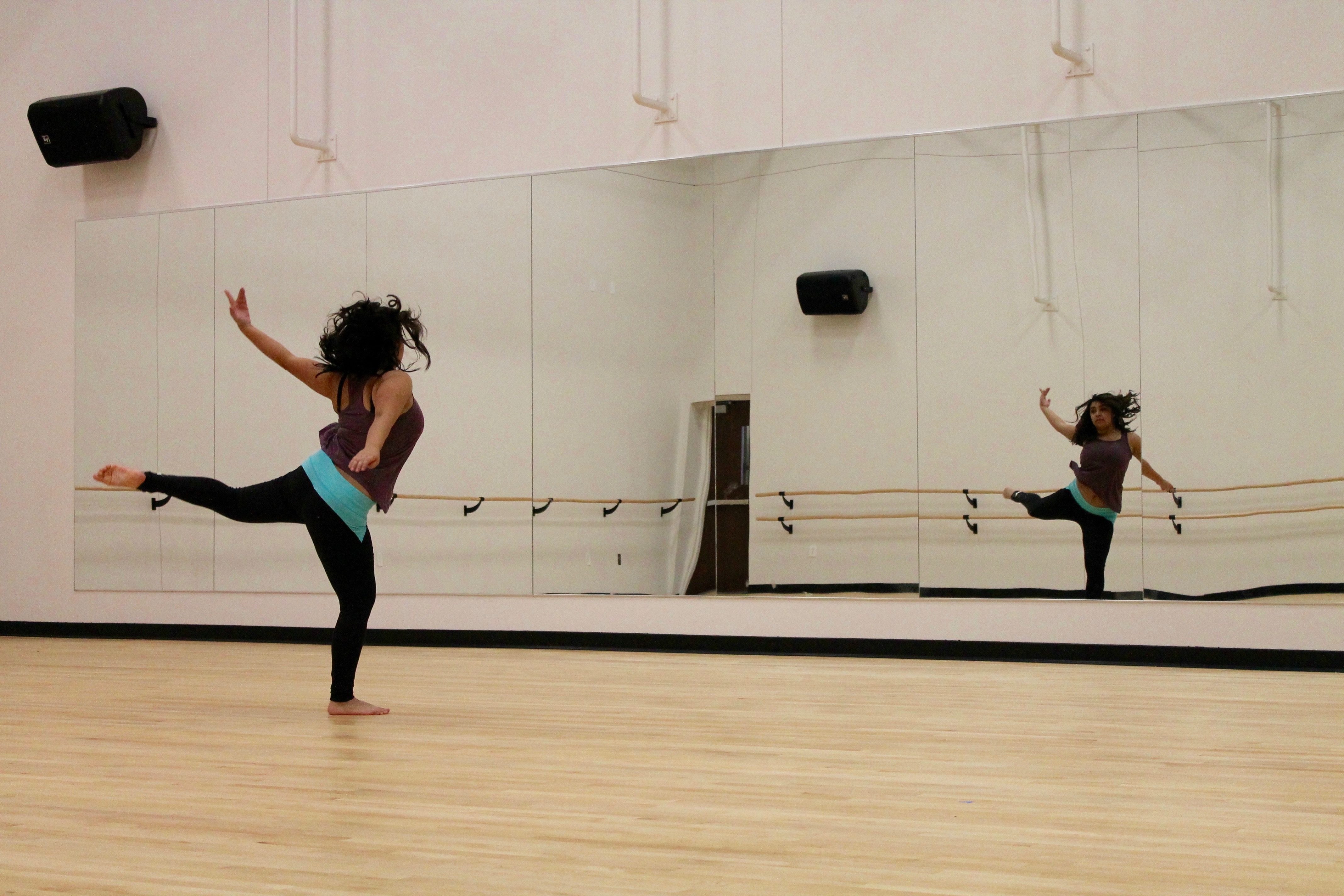
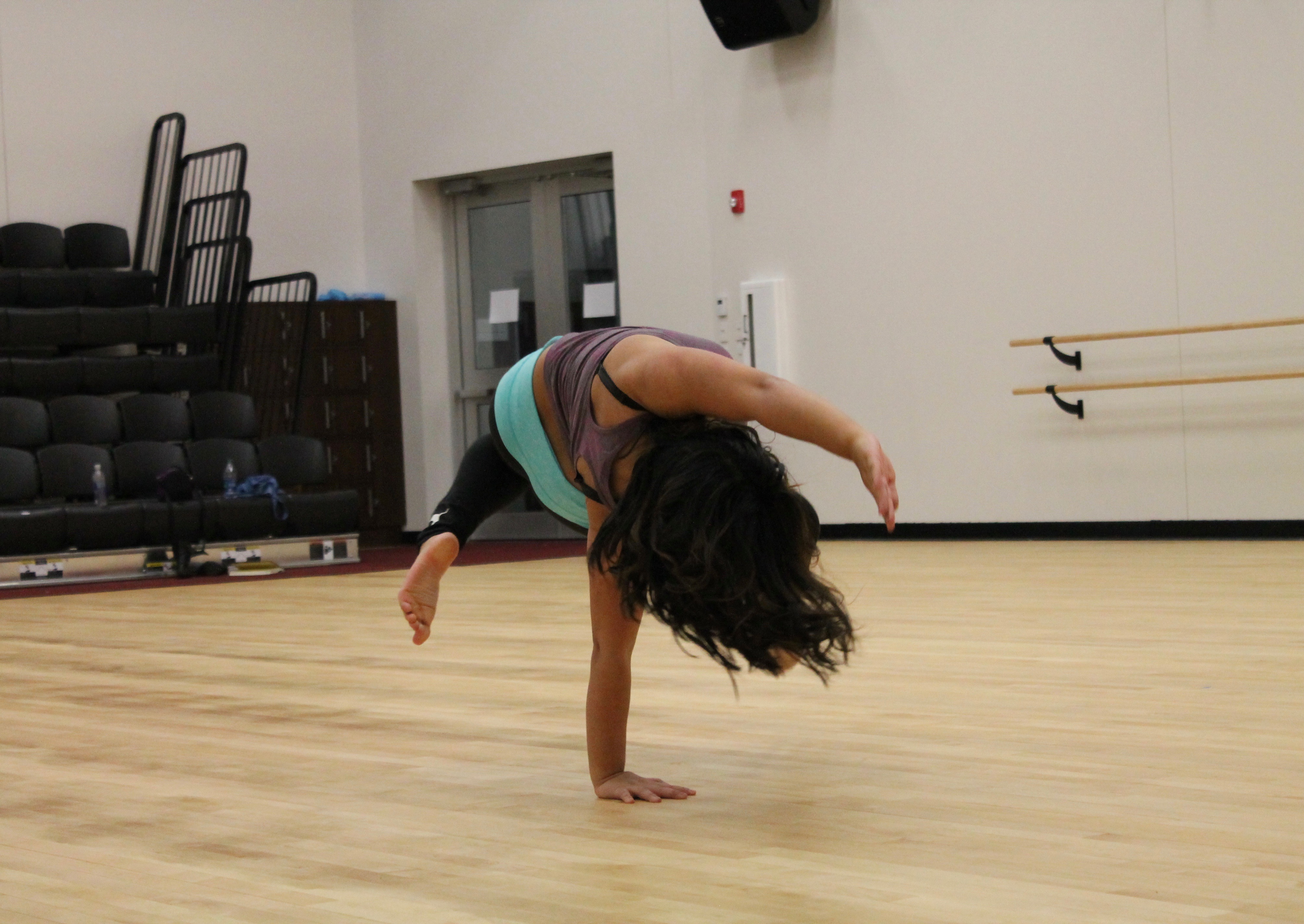
Senior Yasmin Radzi didn’t always like dancing.

Photos by Olivia Lease.

Her mother, Fauziah Embi, was open about this. “The funny story is, I tried to start her earlier [in dancing] when she was five, but she hated her teachers.” A few years later she had Radzi try dancing again and, “she loved it, hasn’t stopped since.”

The Houston-raised dancer is currently president of the student-run dance organization Terpsicorps and majoring in both neuroscience and theatre and dance.

Radzi has trained in ballet, tap and jazz. She was also a part of a competition jazz team and a contemporary company before coming to OWU.

“Ohio Wesleyan was a place that encouraged me to continue my passion of dancing, but also to pursue neuroscience,” she said.

At OWU, she said she’s learned a lot, especially about composition and choreography as an art.

IMG_2288Rashana Smith, assistant professor of theatre and dance said, “Her first piece I saw in Orchesis had to do with light, I really liked that piece a lot just because she worked so hard on it and in many ways, although it had to do with light, it also had to do with architecture.”

Radzi said there’s been an underlying theme for her work these past four years. She likes to focus on the idea of architecture and the idea of dealing with boundaries, how one can push them as well as embrace them.

“For my senior project, I wanted to push my limits. All of my previous work had to deal with revealing and hiding within boundaries.”

Radzi is pushing the limits by filming, editing, directing and choreographing her own senior project.

She’s looking at dance for camera work, specifically film. Smith said this style became popular around the 1940s, but has not been explored extensively at OWU.

Radzi said that for the most part, she had always seen dancing performed a frontal view where the audience is seated, but for her senior project she wanted to do something different. “I wanted to be able to use a medium that would allow me to view movement from many angles.”IMG_2334

The setting for her film will be a storage closet on campus.

“She’s really determined, she cares a lot about finding her creative process. She’s dedicated to the field of dance,” said Smith.

When asked if she gets nervous on stage, Radzi replied, “I love performing, [it] is one of the most rewarding things I think that I will ever feel.”

Her mother said each show Radzi performed in growing up was unique and that she loved them all. Even though she hasn’t been able to see her daughter perform at OWU, Radzi makes sure to send her DVDs of all her performances.

The only thing Radzi wishes OWU offered would be more dance classes, specifically technique-based ones so dancers can keep up on their training. She has already taken every dance class offered.

Radzi will present her senior project at the Spring Dance Showcase on April 24 at 2 p.m.

After graduation, she plans to apply for research positions,  eventually go to podiatry school and join a local dance studio in Columbus.

Investigation into student death continues

Transcript Staff

The investigation into the death of freshman Luke Gabbert continues to progress as results from the autopsy report become public.

“We have the autopsy report, and no obvious cause of death has been found. No visible traumatic injuries were found and the coroner is now conducting forensic testing for internal injuries and also for toxicology, the results of which are awaited,” said Captain Adam Moore of the Delaware Police Department.

Moore said he cannot pinpoint as to when those other tests will be received but they do not think foul play was a factor in Gabbert’s death..

As for where the investigation is headed next, Moore said they are looking into what Gabbert’s whereabouts were prior to him being found and also looking into who he may have been with.

A pedestrian called police about 10:30 a.m. Saturday, Feb. 6, after noticing a body in Delaware Run creek south of a building the first block of South Franklin Street near OWU’s campus.

He said investigators are trying to piece together a full timeline of Gabbert’s activities between the night of Feb. 5 and the discovery of his body.

Anyone who came into contact with Gabbert on the night of Feb. 5 or the morning of Feb. 6 is asked to call the Delaware Police Department at 740-203-1111.

The Transcript will continue to update this story as more information becomes available

Vigils held in remembrance of Luke Gabbert

Transcript Staff

Luke will never be forgotten.

This was said by Carson Miller, an old friend of Luke Gabbert’s, as well as several others in the wake of his body being found just off of Ohio Wesleyan University’s campus late Saturday morning.

There are certain things that bring the OWU community together and one of those things is tragedy. On the night of Gabbert’s death, students gathered on The Hill for a vigil in his memory.

Photo by Olivia Lease.

Delta Delta Delta sorority member senior Megan Ryan put it out to students soon after hearing the news.  As word spread quickly over 300 students gathered to grieve with the community they all share.

Gabbert was a soccer player, a pledge of Phi Kappa Psi fraternity (Phi Psi) and a member of Athletes in Action. All of these communities he touched were present at the vigil.  Students braved the cold to honor his memory.

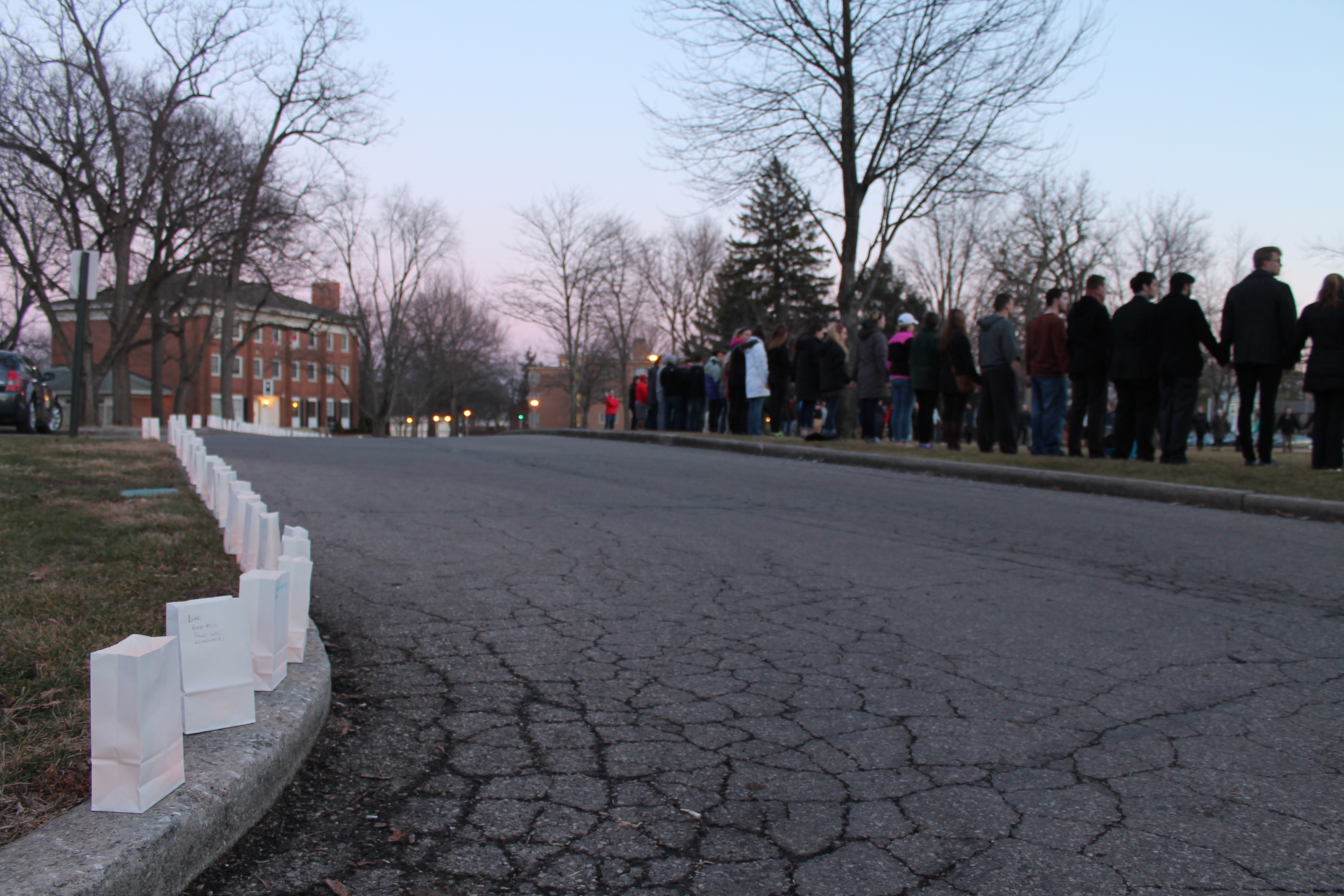
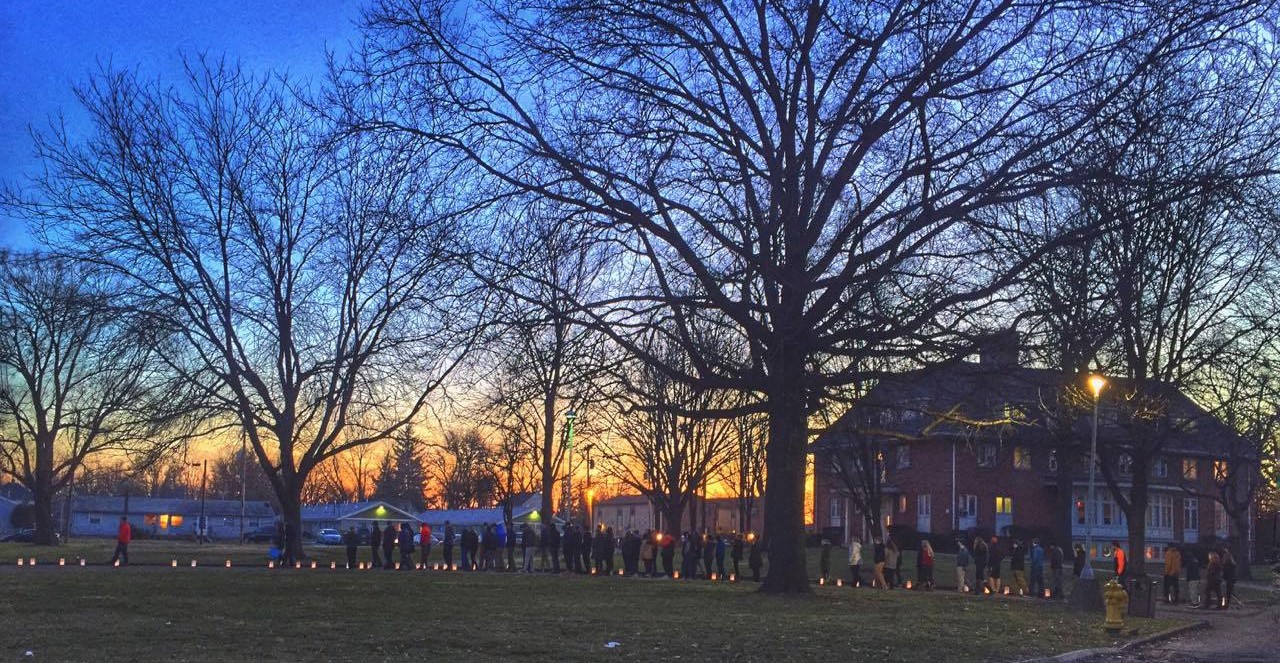
Students and members of the OWU community had the opportunity to light a candle and write a prayer on white paper bags that were lined around The Hill. They were able to remember Luke and the things he loved.

Gabbert’s neighbor Julie Feasel said, “He was always smiling and just last Sunday I saw him leaving his house with a big smile on his face.”

Students were seen comforting each other holding hands, giving hugs, and consoling emotions with comforting words.  At one point everyone was circled all the way around the Hill holding hands in a moment of silence for the deceased.

At the end of the vigil the attendees walked around the circle on the hill to look at the prayers and messages people wrote for Luke.  Messages read “Miss you roomie” and “Rest in Peace Luke.”

Director of Mission, Chad Johns, Director of Greek Life, Susie Long, and the President of Phi Psi Doug Dodridge all spoke to the students in attendance, comforting them and thanked everyone for coming. 

Photo courtesy of Syed Raza.

Associate Chaplain Lisa Ho said, “The vigil was a beautiful illustration of all that is good about the OWU community. It was the strength of community coming together in the midst of tragedy to honor a young life lived well.”

“We only had four lighters, not realizing that we were going to light 315 candles,” said Ryan. “Four people showed up together, 10 people showed up together, entire sororities and fraternities showed up together, sports teams gathered, and then just like that, almost 400 people were gathered together, crying, holding hands, and being there for each other.”

Ryan said she hopes to make a collection of the bags and give them to the Gabbert family. “Luke truly touched so many lives,” she added.

Photo courtesy of Marco Ventresco.
Photo courtesy of Marco Ventresca.

A memorial for Gabbert was also held at Pioneer Field at his high school on Saturday, Feb. 6 with over a hundred people attending.

“Everyone was hugging each other a little tighter last night. He touched all our hearts and was with us in spirit. He is looking down on us letting us know it is okay,” said Marco Ventresca, Gabbert’s friend from elementary school days.

A GoFundMe fundraiser has been set up to help Gabbert’s family with the funeral costs.

The GoFundMe was created by a friend of the family, Jody Spriggs, in an effort to make the process even the slightest bit easier, said Ventresco.

OWU men’s soccer coach Jay Martin was open to talking about one of his former athletes. A long time coach of Gabbert, he said he is sad to see such a talented kid go. Martin was not only his coach at OWU but had also worked with Gabbart on the field during summer soccer camps.

Martin said Gabbert was studying physical education and dreamt of becoming a coach and teacher.

Martin also said the university plans to hang a banner featuring Gabbert’s name and number at OWU’s soccer field in his honor. He said the team will retire the number 19 in his honor. He wants people to know that the support from the community has been amazing and is appreciated. 

Miller, who had known Gabbert for 9 years, said, “[Luke] did everything for everyone else and did not expect anything in return. He was so lovable and loving...No one is ever going to forget Luke.”

In just six hours, friends, family and well wishers of Gabbert came together to raise over $8,000 for the family to cover funeral costs. To view the GoFundMe account, click here.

UPDATE: The calling hours and Celebration of Life services will be held at Grace Church of Powell, 7600 Liberty Road, Powell, Ohio. Calling hours will be from 3 p.m. to 7 p.m. on Friday, Feb. 12, with a service at 11 a.m. on Saturday, Feb. 13.